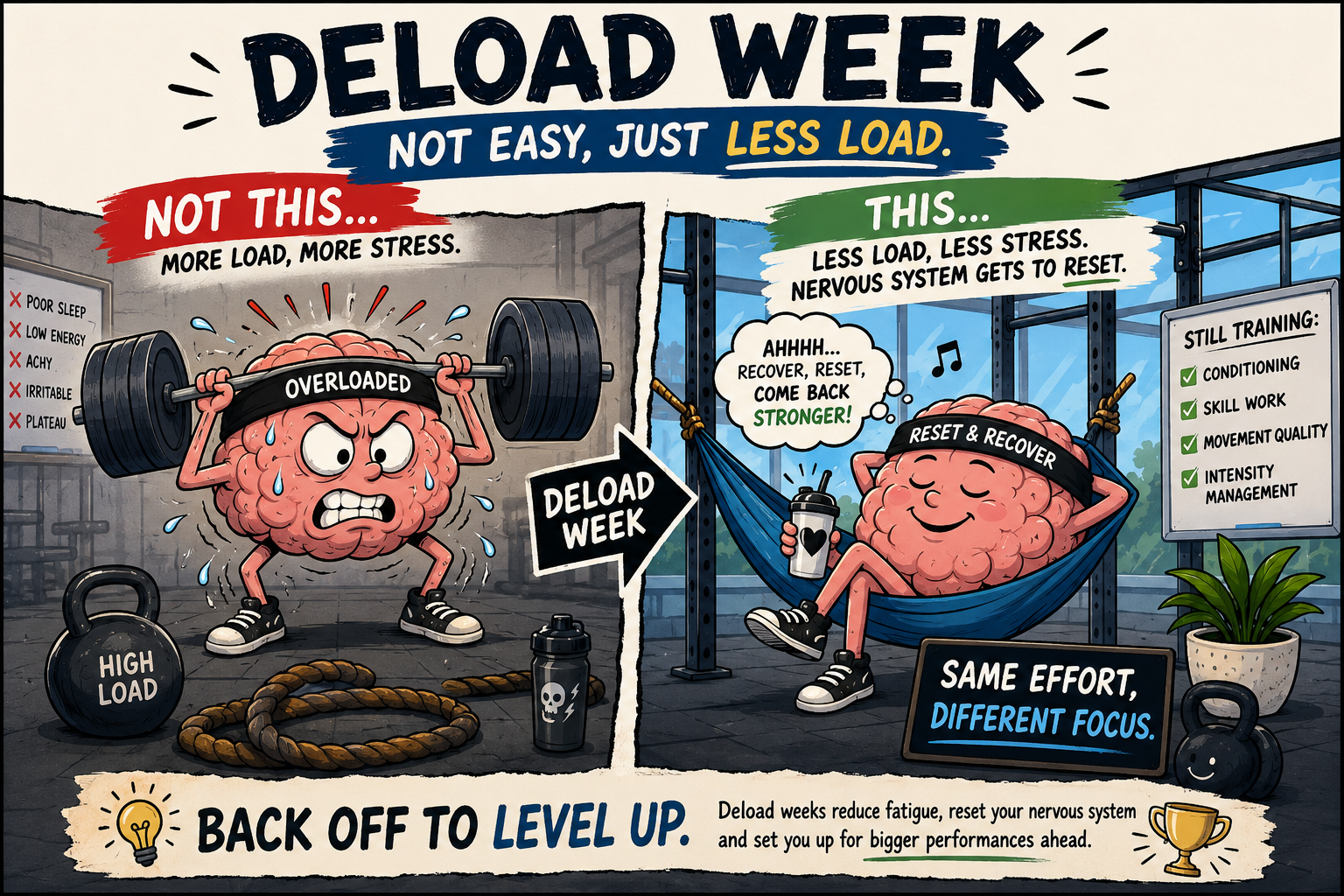
Deload Week: Why Training Lighter Can Help You Perform Better
You’ve probably heard your coaches mention that we’re heading into a deload week.
And when you hear the word “deload”, you might immediately think:
Sweet. Easy week.
Then you look at the WOD, finish the session lying on the floor wondering what just happened, and think:
“How was THAT a deload?”
Here’s the important part:
Deload doesn’t mean easy. It means less load.
And there’s a very good reason we program it that way.
What Is a Deload Week?
A deload week is a planned period in your training where some of the overall training stress is intentionally reduced, particularly the amount of heavy loading your body is exposed to.
Training itself is a form of stress.
That stress is important. It provides the stimulus that eventually helps make us stronger, fitter and more capable.
But more stress isn't always better.
Over a training block, we gradually accumulate fatigue. Heavy squats, Olympic lifting, pulling from the floor, pressing and high-intensity CrossFit workouts all place demands on our muscles, joints and nervous system.
A deload week intentionally reduces some of that demand.
At CrossFit Access, that will often mean reducing the amount of heavy loading you're exposed to for the week while continuing to train.
Think of it less as taking your foot completely off the accelerator and more as giving your body an opportunity to recover before we ask it to perform again.
What Are the Benefits of a Deload Week?
One of the biggest misconceptions about training is that improvement only happens when we're pushing harder.
Training provides the stimulus.
Recovery is where we adapt to it.
If we continually pile fatigue on top of fatigue without giving the body enough opportunity to recover, eventually our performance can suffer.
Weights can start feeling heavier than they should. Movement quality can drop. You might feel flat during sessions or find it harder to hit numbers you would normally be capable of.
A well-timed deload can help:
- Reduce accumulated training fatigue
- Give your muscles and joints an opportunity to recover
- Reduce some of the demands of heavy training on the nervous system
- Improve movement quality and technique
- Prepare you for the next training block
- Support more consistent long-term performance
In other words, we aren't taking a step backwards. We're preparing your body to take another step forward.
Why Can a Deload Week Feel Harder?
This is where people understandably get confused.
If it's a deload week, why am I still out of breath?
Why was that WOD longer?
Why are we doing gymnastics or technical movements?
Why am I still sore?
Because we're deloading, not necessarily taking an easy week.
The overall training stimulus can change.
Instead of regularly asking you to move very heavy loads, we might program slightly longer conditioning pieces, lighter barbell cycling, more bodyweight work or movements that require greater skill and control.
So yes, a deload WOD can still be challenging.
Your heart rate might still get high.
Your lungs might still be working.
And you may still walk out of the gym knowing you've trained.
The difference is that we've deliberately reduced some of the heavy loading and accumulated stress that comes with our normal training.
Deload Doesn't Mean Low Effort
This is probably the most important thing to understand about a CrossFit deload week.
Less load doesn't automatically mean less effort.
You can still train hard while changing the type of stress you're putting on your body.
That's why some deload workouts might actually feel harder than expected.
A longer conditioning workout with lighter weights can be incredibly challenging, but it places a different demand on the body than repeatedly lifting close to your maximum.
The goal isn't to stop training.
The goal is to change the training stress.
Deload Weeks Are a Great Time to Develop Skills
Reducing heavy loading also gives us an opportunity to shift our attention toward another important part of CrossFit: skill development.
When you're not constantly focused on lifting heavy, you have more room to work on how well you move.
That could mean spending more time on:
- Olympic lifting technique
- Gymnastics
- Double-unders
- Barbell cycling
- Movement positions
- Pacing
- Mobility
- Overall movement quality
And sometimes skill work can be frustratingly hard!
A lighter snatch performed with better positions might challenge you differently than simply trying to put more weight on the bar.
That's part of the point.
We're still training. We're just changing what we're asking your body to do.
Do I Need a Deload Week If I Feel Good?
Yes, and this is an important distinction.
A deload isn't something you only need when you're exhausted, sore or struggling.
Ideally, we don't want to wait until you reach that point.
Deload weeks can be programmed proactively to help manage fatigue before it becomes a bigger problem.
If you've had a great training block and you're feeling strong, that's fantastic.
The temptation can be to think:
I feel good, so why would I back off now?
Because we want you to keep feeling good.
Long-term progress isn't about seeing how many hard weeks you can survive in a row.
It's about creating a sustainable cycle of:
Train → Recover → Adapt → Build → Repeat
That's how we continue making progress over months and years, not just from one workout to the next.
Don't Turn Deload Week Into Test Week
There's one other thing we need from you during a deload.
Let the deload do its job.
If the programming calls for lighter percentages, don't add weight because you're feeling good.
If we're asking for quality movement, don't automatically turn it into a race.
And if your coach tells you to pull the load back, trust the process.
We know it can be difficult, especially when you're feeling strong and motivated.
But there's a bigger picture behind the programming.
Every week doesn't need to prove how fit you are. Some weeks are there to help make you fitter.
Are Deload Weeks Important for CrossFit?
For people who train CrossFit consistently, managing training stress is an important part of making sustainable progress.
CrossFit asks us to develop strength, endurance, gymnastics, power, speed and skill, often within the same training week.
That's one of the things we love about it.
It also means intelligent programming needs to consider not only how hard we can train, but also how we manage fatigue across a training cycle.
Deload weeks are one tool we can use to do that.
They allow us to temporarily reduce certain training demands without simply telling everyone to stay home for a week.
You keep moving.
You keep training.
You keep developing skills.
We just change the focus.
The Bigger Picture: Sometimes Less Load Means Better Performance
Deload weeks aren't lost training.
They're part of training.
Reducing load gives your body an opportunity to recover from the accumulated demands of the previous training block while still allowing you to move, practise skills and maintain your fitness.
So the next time you see DELOAD WEEK on the programming, don't expect five days of easy workouts.
You might still breathe hard.
You might still be challenged.
You might even find some of the workouts harder than expected.
Just remember:
Deload doesn't mean easy. It means less load.
Sometimes backing off a little now is exactly what allows you to perform better when it's time to push again.
Frequently Asked Questions About Deload Weeks
What is a deload week?
A deload week is a planned period where certain training demands, particularly heavy loading, are reduced to help manage accumulated fatigue and prepare the body for future training.
Does a deload week mean easy workouts?
No. Deload means less load, not necessarily less effort. Conditioning workouts may still be challenging, and the week may include longer workouts, technical movements or additional skill work.
Why do CrossFit gyms program deload weeks?
Deload weeks can help manage accumulated training fatigue while giving athletes an opportunity to focus on movement quality, conditioning and skill development before beginning another training block.
Should I still train during a deload week?
Generally, yes. A programmed deload isn't necessarily a rest week. Follow the intended loads, percentages and stimulus your coaches have programmed rather than adding extra weight or intensity.
Will taking a deload week hurt my progress?
A properly programmed deload is designed to support progress, not interrupt it. Managing fatigue can help you arrive at the next phase of training better prepared to perform.
Ready to put it into practice?
Check the week's programming, listen to your coaches and remember the goal when you walk into the gym:
Same effort. Different focus. Less load now, so we're ready to perform when it counts.
CrossFit Access | Wangara, Perth